Showing posts with label Sexism. Show all posts

Sep 24, 2013

So this is emergent care?

My teammate and I were sitting on the plethora of abandoned chairs in the emergency room. It was an odd time of the day for people to show up--right around lunch time--and it wasn't the right weather: too cold to be outside and accidentally or intentionally get hurt. Yet there were still patients in about half of the rooms, and because we were on call, all those patients who could be deemed fit for admission had to be processed by us. While we had been interviewing a man with suprapubic pain suspicious for bladder cancer, nearly continuous screams were emanating from a female patient nearby, drowning out the sounds of televisions, beeping monitors, and phone calls. I've been getting better and better at ignoring people screaming in hospitals. But this woman was loud and persistent and every once in a while I could hear the crashing of equipment or cheap furniture, and I'd wonder why a code hadn't been called yet or why nobody had tried to administer drugs.

I was incredibly saddened that the screaming had stopped--it is secretly my dream to rush in to help with a "Paging Dr. Strong" or "Code Grey" (combative patient/person). Alas, today was not going to be that day. Our intern had disappeared again so we had little to do except periodically check up on our patients through their electronic medical records. And then... an Emergency Medicine resident swept by and without hardly stopping asked: "You medical students?" "Yea," we both answered. "I need one of you to follow me." I started asking why as my friend was already standing up to follow him--she is way more instinctively helpful than I am. "To chaperone." Only as they were entering one of the private rooms did I kind of understand. Female patient. Delicate issues. Male doctors needed a female in the room. How obnoxious and unnecessary. So this is where politically correctness was taking us, that male doctors were no longer trusted enough to perform gyne check-ups without female supervision. 

Shortly thereafter, I was pulled away by one of the resident's on my internal medicine team to help out with ABG draws and paper work and phone calls. Eventually my teammate pages me.

"Hi Elora. It's Rebecca. Where are you?"
"The residence room. Why?"
"Okay. I need to tell you something. Will you be in the residence room for long?"
I looked at my computer screen, at the list of patients who were awaiting results of labs and imaging.
"Yea I'll be here."

to be continued. 

Apr 4, 2013

Gender Discrepancies (I/II)

Did you know women and men are actually quite similar? We really are. If we were all raised in a society that interacted with the two genders in the exact same way, we'd probably end up like some gender-neutralized weird race of alien a la Star Trek: The Next Generation. We'd still have the two separate sexes, but we probably wouldn't have this weird, polarized, gender dichotomy. The terms tomboys and janegirls, for example, would no longer make sense and be cast aside like the frivolous trash they are.

Yesterday, in our community groups (which is basically a quarter of our class plus one practicing physician from the surrounding area), we were asked to talk about American health care. We were asked vague questions by our community leader and what ensued was kind of hilarious and also pretty depressing.

On a side note: I talked entirely way too much, which is unfortunate because I hate people who act the way I acted yesterday in class. I will have to implement a more stringent foot-in-mouth policy for any future large discussion groups. I am also a crazy liberal. I need to stop telling people I'm a moderate since I clearly believe that taxes are necessary and the government should govern our personal liberties as little as possible (but I still think we should all have access to affordable health care because it should be a personal liberty).

There were a lot of nuances in our overall debate--this is to be expected since if we could formulate a clear solution to the health care problem in an hour and a half, than our government, as crappy as it is, would already be enacting such solutions as policies nationwide. But in the end, clumping all the nuances together and then defenestrating them because who actually gives a **** about nuances?--there were only two general positions a person could have: you believe Universal Health Care should be guaranteed for everyone or you believe that Health Care should be payed for by individuals in some way outside of paying taxes.

Good points can be made for either side, but as you recall, I threw all those nuances out the window, and it seemed for the most part that the most avid supporters of the opposing sides were also of opposing genders. Universal health care is somehow more appealing to more women than it is to men.

Although clarifying point: my sample size was quite small (n=48) and it wasn't as if no men liked the idea of universal health care. Some favored it. Also, not everyone talked so the real sample size is closer to around 20. So I might just be making up a ton of crap, in which case, I'm sorry if the following is just super offensive. 

I am trying to figure out why that is. Last year when I went to the American Medical Women's Association's National Conference in Miami, the keynote speaker kept commenting on how women are dearly needed in the medical field because women are natural healers and we just care more. It was pretty inspiring but it seemed kind of hurtful to the small amount of dudes I knew who are actually pretty loving people. But now that I think about it, do I actually know any guys who are selfless? Or are they just decent human beings who have yet to have their selflessness tested? How selfless are they, really? Because I don't think caring is quite enough. I care a lot about things but don't actually do anything about it because I am selfish. I really care about making sure people understand that America's  oppressed groups aren't all good to go now that we've slapped band-aids--Title IX and Affirmative Action--on the gaping wound that is injustice. But all I actually do is update my status on Facebook, maybe including a link to a blog article or a recent study.

But when I think about selflessness more, I realize a better question may be: do I know anyone who is selfless? 
Not many.
Well, that's depressing, seeing as I am in Medical School. But I guess everyone isn't being "selfish" per se, just too busy studying so that they can one day be selfless. <<>> This seems too nuanced. I will stop ruminating. 

If we just assume women care more, why is that so? Is it because we have the capacity to become mothers? Because men have the capacity to become fathers, which I have been assured can also be a full time job. Both of my parents were full time Surgeons, and I am sure they both cared about me equally, but I saw my mom much more than I saw my dad, so can we assume my mother was more selfless than my father? I think that is a far argument. Although we will never know for sure because my dad may have thought that by working longer hours, he would be able to give us more opportunities with the money he'd make, and to him, that would seem like a more valuable pursuit than teaching us how to tie our shoes. My dad may have been selfless. Conversely, my mother may have spent more time with us to show the world that she was not only capable of being a woman and a surgeon, but also a loving mother. My mom may have been selfish.

But either way, actions speak louder than words, and I saw my mom more than I saw my dad, even though they had similar jobs. I think this behavior must be socialized, because my mom didn't actually need to spend so much time with us. We could have just had babysitters who stayed at our house longer.

 Now that I've dragged you through my own internal thought process, let me actually tell you facts: female physicians make $17,000-a-year less than male physicians, on average, for doing the exact same amount of work. This number has been normalized, so any arguments that male physicians tend to work longer hours (as was the case for my parents) or that male and female physicians choose to enter different specialties or practice in different locations (as was not the case for my parents) does not at all affect the statistic that women make $17,000 a year less than men for doing the exact same work. Discrimination, of course, plays a role in this inequality, but another interesting point that the researchers brought up was that some of the blame actually falls on women: women will stop negotiating their wages with their employers at a lower rate than their male counterparts. You could see this as women having a lower innate self-worth (which is true in society overall but may not apply to physicians) or you could see this as women willing to do more "caring" for less economic compensation. That sounds a lot like selflessness to me.


Sep 16, 2012

Watches

Since early last year I've been dying to get a watch. I do not know why I associate professionalism with watches, but let me speculate:

1. Pulling out a phone to check the time is "disrespectful" (your older professors will assume you're getting a quick round of "words-with-friends" in).
2. Being successful but also professional means having functional bling. If I get a doctor's bag, it's going to be the most abstract Vera Bradley pattern I can find. If I have an excuse to have a watch, it will be like a crazy beautiful watch. It won't be like I'm "dressing" up (which would be unprofessional) because I actually need a timepiece (... well I mean technically. I think I can make the argument that I need a time piece).
3. It just feels like a doctorly thing to have. I want to be standing over a patient, taking their blood pressure, their heart and respiration rates, and instead of staring at a wall, I want to be looking somewhat at the patient so I don't seem distant. I also feel like there are a lot of portraits of doctors looking at their watches while assessing a patient's vitals.
4. Also, most obvious: being late is unprofessional. You can lose "professionalism points" from our clinical reasoning course by being late to lab. So yea, punctuality is professional.

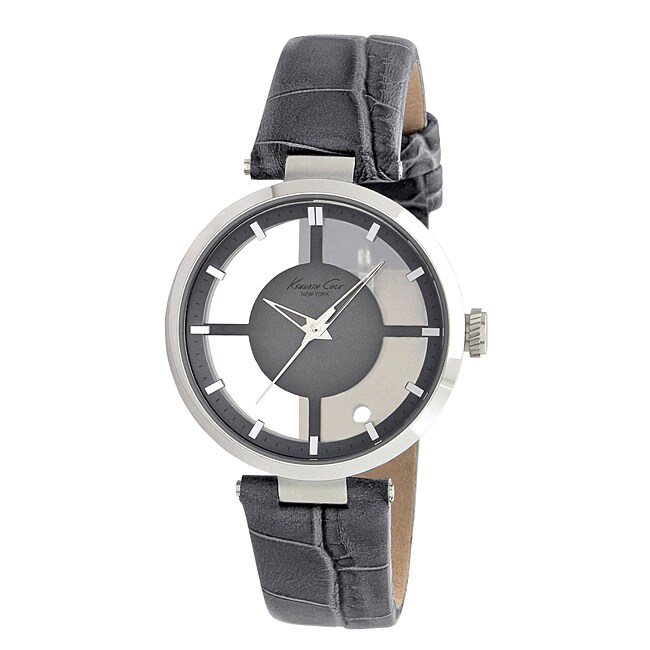
Consequently, I've been obsessed with finding a watch. Stylistically, I'm pretty "out there," so the challenge is to try and find something that expresses my personality but doesn't force my personality onto others (or worse, offends people). I also don't want to drop much more than $100, so I went to overstock.com because it's really difficult to find cool watches for women. I guess time is more of like a "dude thing." I don't know and I didn't really care, until, after scrolling through about 500 watches I see this atrocity:


Not only is this thing disgusting, it also asks a very important question: why isn't there a "whimsical women's doctor theme white leather watch"? I do not think I want to put on an air of "whimsicality" when I begin rotations next year, but dammit, I want a doctor's watch made for my womenly wrists!

Well, I have since searched overstock.com for a doctor's watch, and they don't have any. I tried searching for "professional" watches, and of the 40 results I got, 39 of them were men's watches. The one female watch was for "professional divers." Which I guess is cool and stuff because hey! I would've never thought women could descend to the same depths as men due to their whimsical womenly constitution's and other almost-trivial-but-still-obnoxious sexist b***s***. 


Anyway, rant over. If you're curious, I bought the above two watches. The one on the right is transparent, which means I've finally gotten something that's actually my skin tone.... which is another thing I could complain about. But I won't. Since like, I'm in medical school and am like, totally busy and schizz.

Jan 30, 2012

All's Fair in Love and Warfarin?

During our orientation week, we were discussing how medical studies were often biased against underrepresented minorities. I was well aware of how drug companies will sometimes choose to only study genetic lines that they see as more "profitable." For the most part, this doesn't bother me too much. I get upset when I think that some people's lives are put in danger because drug companies haven't done enough research on how the drug differentially reacts with the large variance in human genotypes. Warfarin, an anti-coagulant, is a good example. But it's technically a free market, and there is a lot of genetic variation in the human population--I understand that you can't study everyone.

That being said, I was enraged when my thoughts on this topic were put succinctly by a female professor at the University of Illinois. I found this article on the blog io9.com. It's a pretty good blog, and they post enough science and medical articles to be interesting for anyone interested in science and medicine:


University of Illinois anthropologist Kathryn Clancy, who studies medicine and gender, told me that her "sexapocalypse to celebrate" will come when gender bias is drained out of medical studies. She imagines a world where:
Gender bias no longer influences pharmaceutical priorities or federal funding, and when we accept a wider interpretation of normal variation in human form and function. Issues like why black women have higher mortality rates for breast cancer, or why postpartum hemorrhage seems to strike so randomly yet is so deadly, or the black box of transgender reproductive health, all would be resolved before cures for erectile dysfunction or baldness. Finally, we would do away with all the underfunded, misunderstood syndromes – polycystic ovarian syndrome, chronic fatigue syndrome and premenstrual syndrome, to name just a few – and start to identify the origins of these clusters of symptoms.

In Chicago it is certainly true that black women have a higher mortality rate from breast cancer than white women. I actually helped my aunt--who works with public health at the University of Illinois at Chicago--with a project that would help inform black women where they could go to get free mammograms. It's one of the things that I would like to do more with in the future.

But to be honest, I'm also quite upset that no one seems to be working on a female Viagra. Either people assume that it wouldn't make as much money (which may or may not be true) or they assume that there isn't any need for it. Either way, the lack of adequate care for women, of all races, in this country is pretty substandard. It's not just "silly" things like female viagra, or spending more money on male problems--it's larger care situations where women are regularly put at a disadvantage. Whether it's the government putting up legislation to make birth control inaccessible for poorer women, or the fact that female heart attacks are less successfully diagnosed than men's, there's still sexism in health care.

Aug 7, 2011

How Doctors Think

In anticipation for orientation, I've been reading How Doctors Think by Jerome Groopman, MD. It was interesting, and I was immediately compelled to finish the 200+ page book after he references and quotes Judith Hall and Debra Roter in the introduction. Hall and Roter are two researchers who have looked extensively at doctor-patient interaction and communication styles, and I referenced them a lot in my Rhetoric thesis that examined communication in health care. The book was eye opening in that it did a great job of informing the reader about which types of cognitive errors bias the way doctors treat their patients. Absolutely fascinating. I've always found that understanding logical fallacies allows you to deal with people and to make sense of complicated situations. To know that there are several logical fallacies that even well intentioned doctors make frequently is reason enough to write an entire book.


I have two concerns with Dr. Groopman, however. First, he seems to be praising all the doctors he talks about (with a few exceptions). I wonder if it would be more useful for people to know how bad doctors think more so than to understand how competent doctors deal with diagnoses, because sometimes you aren't given the liberty, although you should have it, to choose your clinician for yourself.

My second concern is more insidious and/or uppity. Paternalism. It's clear that Dr. Groopman is against it. He is quick to praise a few doctors who unbiasedly talk to their patients in order to make sure that their patients choose their treatment for themselves and aren't subjected to being helpless to control their own medical destiny. But Dr. Groopman has a severe pronoun problem. Even though he talks about two or three excellent female physicians, he always refers to doctors as hes. And I guess that wouldn't be unforgivable, because grammatically he can be used as a gender neutral pronoun, even though it no longer carries that meaning for most readers. No, what makes it unforgivable is that he often refers to hypothetical patients as shes. He even ends his book talking about this hypothetical patient, and how she is adding vigor to the clearly sexist clinic by being an expert communicator and able to understand her male physician's every thought.

Gross. When the movement began to minimize paternalism in the clinic beginning in the 1970s, paternalism was symbolized by the interactions women had with men in that time. Women don't make decisions. They let their husbands decide for them. Because men and doctors generally have an elevated standing in society compared to women and patients respectively, this visualization makes sense and should strengthen a progressive individual's will to end clinical paternalism at all costs.

Though the insight that Groopman has into clinical practice makes it easy to forgive him. Also, the fact that he's in his sixties or seventies and trained during a much more... sexist time, makes it a burden, but an acceptable one, to not get overly upset and just take value where there is some and ignore the rest.

Debra Roter and Judith Hall are two excellent female researchers. They have looked into the differences in communication styles between male and female physicians and are aware of the challenges facing women in health care. I wonder if they, after reading Groopman's book, noticed this slight rhetorical misdeed, or just conceded that there are some minor injustices you just have to accept.