There it was. The truth. Stretched out in front of me like the end of days. And loudness. So much strife and bustle. Everywhere. Cars and the people with their voices and the humming of buildings with their AC units pumping in cold to isolated rooms separated from the world and the streets within the city of Chicago. And the El up ahead a block, three or four stories high with always the same voice alerting passengers and future passengers alike: "Doors opening." Then two bells. Then: "Doors closing." This was my present but less than an hour ago I was in a completely different world. Oppressive silence. The distant sounds of mouses being clicked at other terminals was the only thing to distract the dull buzz that came with inactive listening from taking hold on my ears. Distant, fluorescent lights. Everything controlled. And cold. So cold. That was the world of the United States Medical Licensing Examination Step 2, the second of three licensing exams. And I realized on the streets of Chicago, I could not remember a single question. 355 questions. 9 hours. And I couldn't remember a single thing.
What could possibly be more horrifying?
Step 2 is a serious exam, of course, otherwise, why would we have to pay $580 to take it? If cost equals quality, then Step 2 is a lot more important than the scantrons and blue notebooks I used to use in high school to take advanced placement (AP) exams--which actually helped me take less courses in college, saving me thousands of dollars. I think those cost $25. USMLE tests cost me money to prove that I can be a doctor. I guess if failed enough times, I would have to take a year of medical school again: $50,000. Okay.
AP scores can be dolled out in a simple 1, 2, 3, 4, or 5. Step scores are much much much more complicated. Not always was this so, of course. In the old days, you passed or you failed. Quite simple really. Because we all must be evaluated and found worthy of the MD that will follow our names for the rest of our lives, but do 355 randomly selected and sometimes silly questions mean that we deserve or do not deserve to put our hands on a patient, to share in their suffering, to help and to heal and to comfort and advise? No. They really, honestly shouldn't.
This year the passing score on Step 2 jumped up from 200 to 209. Was this arbitrary? How was this determined? And isn't nine points.... a lot of points? More importantly, if the passing grade was just determined based on how many people passed Step 2--which is the way some courses are run-- wouldn't this imply some kind of insidious ploy to make sure that enough people fail so that the administrators of USMLE can charge some poor soul another $580 and increase revenue? Or does the increased score make everyone feel better that residents are intelligent enough to be able to control and manage possibly dying patients, and the additional money made is just an extra benefit?
How many times have I heard a discouraged patient say something along the lines of, "I know you just see me as money to be made at my expense." Should I also feel the same way, as a medical student, stuck in a world of constant cost with no monetary profit?
Let's assume however, that a lot of thought was made into making it so that 209 was meant to really pick out who would do well as a resident in terms of knowledge. Isn't it possible that there are people who score below 209 who would make good residents because they know how to look up answers on uptodate or even google? And who work hard to make sure that they overcome their deficits? Conversely, couldn't someone with above a 209 simply make the worst resident ever and incur a lot of lawsuits because of they have the worst bedside manner? Or couldn't someone with a +209 score completely slack off for the rest of their career and be unable to provide the standards of care for anyone besides the hypothetical patients he saw before him in paragraphs on a computer screen on test day? I mean statistically, some people who score below 209 will ultimately practice great medicine while people who score above 209 will do absolutely terrible things.
So did I really need to be locked in a room for 9 hours--an amnesia-inducing, cubicle-filled room with no music, no food, no human contact for 9 hours--so that I could answer 355 questions that I would instantly forget and then spend the next three weeks until receiving my score panicking and scratching at my skin, picking at my scabs, and eating antacids like candy because how can you feel like you did well on a test if you can't remember any part of it? Only to find out that I did pass and that I did do well.
All that nervousness and I have to pay $580. Infuriating.

Aug 25, 2014

Aug 14, 2014
Family Medicine Conference
Last weekend I drove eight hours to Kansas City, Missouri for a national conference for residents and medical students in and interested in family medicine. My specialty adviser suggested I go since almost all of the residency programs in the United States set up booths to interest and inform students. I require a few more weeks of electives in the year, and it was her hope (and mine, too, although I am always much less optimistic about my ability to socialize and form plans with strangers than most people who know me) that I'd be able to establish some sort of elective in rural medicine there.
I did not.
All totaled, the weekend cost me around $800 - $900. But I would have gone back if I had the choice, because despite being really draining to walk among so many strangers constantly, it was really inspiring. I feel really inspired. I have felt this way previously at the end of AMWA conferences, so I can only assume I love conferences more than I love school.
The lecturers were phenomenal. They were so passionate. And so funny. And so personable and nice. After spending a year interacting with doctors who seemed dissatisfied with their career choices, it was nice to see people loving what they did.
And everyone spoke in such a way as to relate several main themes:
1. Many physicians think family medicine is a joke but that is slowly changing.
2. There's a lot of good you can do as a family physician--be it for your patients or even in changing politics.
3. Job satisfaction. Family practitioners have more of it.
There were more ideas but I've started having a hard time writing anything of importance. More to follow.
I did not.
All totaled, the weekend cost me around $800 - $900. But I would have gone back if I had the choice, because despite being really draining to walk among so many strangers constantly, it was really inspiring. I feel really inspired. I have felt this way previously at the end of AMWA conferences, so I can only assume I love conferences more than I love school.
The lecturers were phenomenal. They were so passionate. And so funny. And so personable and nice. After spending a year interacting with doctors who seemed dissatisfied with their career choices, it was nice to see people loving what they did.
And everyone spoke in such a way as to relate several main themes:
1. Many physicians think family medicine is a joke but that is slowly changing.
2. There's a lot of good you can do as a family physician--be it for your patients or even in changing politics.
3. Job satisfaction. Family practitioners have more of it.
There were more ideas but I've started having a hard time writing anything of importance. More to follow.
Jul 25, 2014
A Scribbled Story on the back of my Ob/Gyn Orientation Packet
The woman was clutching her left shoulder with her right hand. Intermittently, as she spoke, she would press against it, as though she could fix her heart by coaxing the arm into a well-massaged, relaxed and quiescent state. Her skin was loose and wrinkled, falling away from her hands, her arms, her face, her bones that were most likely thinned out and brittle. Despite drowning in her own skin, she looked her stated age of 82. Maybe even a few years younger. I had originally approached her and let my crossed arms lay on the railing that had been pulled up from her emergency room bed. But regardless of my physical closeness and what many have told me is a great bed side manner, the woman did not warm up to me initially. She was serious. She had a serious complaint, of course, otherwise why bother taking a day off work going to the emergency room. She would later tell me that she worked as a Walmart cashier. She loved working there, being surrounded by people. She didn't want this job--this world--to be taken away from her because she didn't take the warning signs of a heart attack seriously.
- true story from my emergency medicine rotation -
Jul 23, 2014
Assumed, Actual, and Average Performance: Preparing for the horrors of Step 2 using the defense mechanism of Intellectualization
In exactly one week (7 days -- 168 hours -- 10,080 minutes -- you get the idea) I will be sitting in a prometric testing center taking, depending on whom you talk to, the most important test I have ever taken capable of determining all of my future career successes, or just something I need to pass to graduate: The United States Medical Licensing Examination (USMLE) Step 2 Clinical Knowledge.
Tensions are running high, but I am actually quite proud of myself. I began studying weeks, no... months ago, and I find that even though I only have a week left, I am doing a lot less cramming than I had to do for Step 1. And I actually might finish reading an entire review book cover to cover. I may actually do well on this exam.
But do you know what's more important than doing well on exams? Knowing, fairly accurately when you leave the testing center, that you have most likely passed the exam with a 95% confidence interval (did I use that term correctly? I still haven't studied biostatistics). Which is why I have begun analyzing my Usmleworld QBank tests. Upon hitting submit, I quietly contemplate how well I think I may have done, remembering how many questions I "knew" verse how many were "good guesses" verse the inevitable "I have narrowed it down to two, equally likely choices" verse "I have not heard of any of these conditions. I will choose the answer choice that seems most viable." Then I write down my assumed score. Then I write down my actual score and the national average for those 44 questions.
What conclusions have I come to? First, my actual performance varies widely. Hopefully over my next tests I can become more consistent, although this isn't likely. I believe this is the nature of any test designed to ask many questions on broad topics.
Second, my predictions are much more conservative than my actual performances. Which is nice to know, although a given: more people feel like they failed an exam than actually did, at least in medical school.
Third, my predictions seem to follow my actual scores fairly closely, although doing really well on test 94 improved my confidence so that on test 95, I assumed I did much better -- even though I in fact did much worse.
And now I have to study for at least six more hours before I can go to sleep. I love summer break.
Tensions are running high, but I am actually quite proud of myself. I began studying weeks, no... months ago, and I find that even though I only have a week left, I am doing a lot less cramming than I had to do for Step 1. And I actually might finish reading an entire review book cover to cover. I may actually do well on this exam.
But do you know what's more important than doing well on exams? Knowing, fairly accurately when you leave the testing center, that you have most likely passed the exam with a 95% confidence interval (did I use that term correctly? I still haven't studied biostatistics). Which is why I have begun analyzing my Usmleworld QBank tests. Upon hitting submit, I quietly contemplate how well I think I may have done, remembering how many questions I "knew" verse how many were "good guesses" verse the inevitable "I have narrowed it down to two, equally likely choices" verse "I have not heard of any of these conditions. I will choose the answer choice that seems most viable." Then I write down my assumed score. Then I write down my actual score and the national average for those 44 questions.
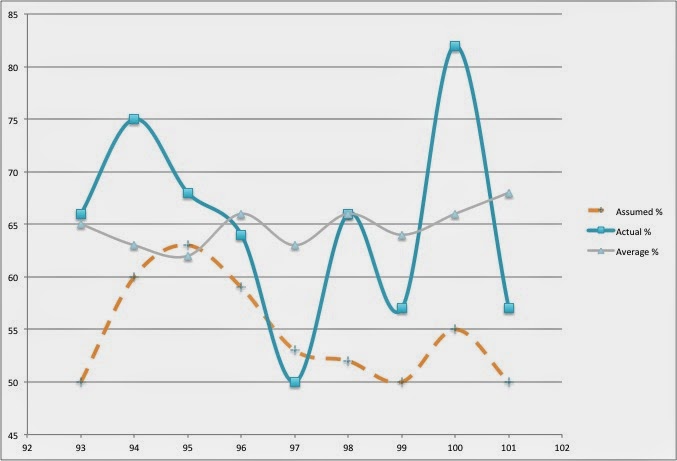 |
| Test Results of QBank tests numbers 93 through 101 |
Second, my predictions are much more conservative than my actual performances. Which is nice to know, although a given: more people feel like they failed an exam than actually did, at least in medical school.
Third, my predictions seem to follow my actual scores fairly closely, although doing really well on test 94 improved my confidence so that on test 95, I assumed I did much better -- even though I in fact did much worse.
And now I have to study for at least six more hours before I can go to sleep. I love summer break.
Jul 9, 2014
"Unique Opportunity" for the PCP (i.e., psychotherapy)
"Primary care practitioners have a unique opportunity to address the emotional needs of their patients, but regardless of their importance, these needs must be handled in a time-effective manner. The psychosocial aspect of patients' problems must be effectively addressed within the regular 10 or 15-minute medical visit. The therapeutic goal is to help patients reorganize some small aspect of their self-concept or behavior in a more comfortable, productive, or, at minimum, less destructive manner. The healing grows out of the established practitioner-patient relationship."
Stuart MR, Lieberman JA III. The Fifteen Minute Hour: Therapeutic Talk in Primary Care. United Kingdom, Oxon: Radcliffe Publishing Ltd.; 2008.
Very interesting thought. And I suppose, a good goal for someone like me who--if I ever become comfortable enough with it--would spend much more than 10 - 15 minutes on therapy with a patient.
Subscribe to:
Posts (Atom)